Topics · Freeway driving
Freeway driving: DMV test questions
Merging, exiting and changing lanes. Here are 49 questions like the ones on the written test, with answers and explanations.
 Video lessonMerging onto the FreewayScared of merging onto the freeway?
49 questions with answers
1. You're on a freeway on-ramp. What should you do?
- Speed up to match traffic and find a gap
- Enter slowly so others can see you
- Just go: freeway traffic must brake for you
- Stop at the end of the ramp and wait
Show answer
Answer: Speed up to match traffic and find a gap
The ramp is for building speed. Merge at the speed of traffic.
2. Approaching a toll plaza, one lane says "electronic pay only" and you have no transponder. You…
- Use it anyway, it's free without a tag
- Swerve across several lanes right at the booth
- Move early to a lane that takes your payment
- Stop in the lane and back up
Show answer
Answer: Move early to a lane that takes your payment
Read the signs early and pick your lane in time. Toll rules vary by road.
3. You're exiting the freeway. When do you start slowing down?
- In the main lane, well before the exit
- Once you're already in the ramp's curve
- Once you're in the deceleration lane
- When you see the first exit sign
Show answer
Answer: Once you're in the deceleration lane
Keep your speed on the freeway. Slow down once you're in the exit lane.
4. You missed your freeway exit. What do you do?
- Make a U-turn across the median
- Continue to the next exit
- Back up along the shoulder
- Stop and wait for a gap to go back
Show answer
Answer: Continue to the next exit
Never back up on a freeway! Take the next exit and turn around.
5. On a multi-lane freeway, if you're driving slower than traffic, use…
- Always the center lane
- The right lane
- The shoulder
- The left lane
Show answer
Answer: The right lane
Right lane to cruise, left lane to pass. Easy.
6. Before changing lanes to pass, you should…
- Only check your rearview and side mirrors
- Signal, check mirrors, look over your shoulder
- Honk and switch quickly
- Speed up first, then signal as you move over
Show answer
Answer: Signal, check mirrors, look over your shoulder
Signal, mirrors, and a quick shoulder check. Blind spots don't forgive.
7. After passing a car, when can you return to its lane?
- When the other driver flashes their headlights
- When you're right beside it
- As soon as you clear its bumper
- When you see both its headlights in your mirror
Show answer
Answer: When you see both its headlights in your mirror
See both headlights in your rearview? There's room. Not before.
8. Driving alongside another car for a long time is risky because…
- Your lights make them nervous
- It's a ticket everywhere
- You may be in its blind spot
- You burn more gas
Show answer
Answer: You may be in its blind spot
Hang beside them and they may not see you. Move ahead or drop back.
9. A lane marked with a white diamond and "HOV 2+" is for…
- Vehicles with at least 2 people
- Commercial trucks only
- Passing at any time
- Emergency and police vehicles only
Show answer
Answer: Vehicles with at least 2 people
Carpool lane: riding solo means it's not for you. Rules vary by area.
10. There's a red ramp meter on the freeway on-ramp. You…
- Roll through slowly without stopping
- Stop and wait for green
- Ignore it, it's only for trucks
- Use the shoulder to skip the line
Show answer
Answer: Stop and wait for green
That little light lets cars in one at a time. Red means stop.
11. After hours on the freeway, your eyes feel heavy and your mind blank. You should…
- Roll down the window and speed up
- Follow the car ahead more closely
- Pull off somewhere safe and rest
- Turn up the radio and keep going
Show answer
Answer: Pull off somewhere safe and rest
That's highway hypnosis. Stop, stretch, rest.
12. Your car breaks down on the freeway. What do you do first?
- Get out and wave at traffic to make cars stop
- Back up toward the last exit
- Stop in your lane and get out to check
- Pull far right and turn on your hazards
Show answer
Answer: Pull far right and turn on your hazards
Get as far from traffic as you can, hazards on. No show in the lane.
13. You're pulled over on the shoulder waiting for help. It's usually safest to…
- Stay inside with your seat belt on
- Sit on the rear bumper
- Stand by the car on the traffic side
- Walk along the lanes for help
Show answer
Answer: Stay inside with your seat belt on
Inside and buckled, unless there's danger like smoke or fire.
14. You enter a freeway work zone. You should…
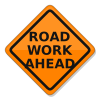
- Keep your speed if no workers are visible
- Pass quickly to get out sooner
- Slow down and obey the flaggers
- Tailgate so you don't lose your spot
Show answer
Answer: Slow down and obey the flaggers
Orange means heads up. Slow down even if nobody's there. Fines can be higher.
15. A police car or tow truck is stopped on the shoulder with lights flashing. You must…
- Keep your lane and speed; they're already off the road
- Brake hard right next to it
- Move over a lane if safe, or slow down
- Drive onto the opposite shoulder
Show answer
Answer: Move over a lane if safe, or slow down
That's the Move Over law: give them room. Details vary by state.
16. Can you drive too slowly on a freeway?
- No, you can never get a ticket for going slow
- Yes, too slow can be unsafe too
- No, slower is always safer
- No, minimum speeds only apply to trucks
Show answer
Answer: Yes, too slow can be unsafe too
Crawling like a turtle causes crashes too. Keep up, within the limit.
17. You're entering the freeway on a long acceleration lane. How do you use it?
- To build speed and find your gap
- Roll slowly along it until someone lets you in
- Stop at its start until you see a big gap
- Cut into traffic right away, even if you're slow
Show answer
Answer: To build speed and find your gap
That lane is your runway, kiddo. Use all of it and merge at traffic speed.
18. Your exit is coming up and it has a deceleration lane. How do you get into it?
- Wait until the lane's end and cut across the line
- Signal and enter at its start, without braking first
- Cross the striped area at the end to get there faster
- Brake on the freeway, then move into the lane
Show answer
Answer: Signal and enter at its start, without braking first
Don't brake on the freeway. Get into the exit lane, then slow down there.
19. The exit ramp has a yellow sign that says "25 MPH." What does it mean?
- It only applies when it's raining or icy
- It only applies to big trucks and buses
- It's the safe advised speed for the ramp
- It's a minimum; you can safely go faster
Show answer
Answer: It's the safe advised speed for the ramp
Ramps have tight curves. If it says 25, listen, even if you just came off 65.
20. In one stretch, some cars enter the freeway and others exit using the same lane. You…
- Stop at the end of the lane and wait for a clear gap
- Speed up hard to get ahead of the cars coming in
- Stay alert, keep a steady speed, and leave room
- Brake suddenly to let everyone else go first
Show answer
Answer: Stay alert, keep a steady speed, and leave room
Everybody's crossing paths there, like a dance. No surprises: steady speed, eyes open.
21. You've finished passing in the freeway's left lane. What now?
- Stay left because it's the fast lane
- Stay left until your exit, even with cars behind you
- Slow down so others can pass you on the right
- Move back right when it's safe
Show answer
Answer: Move back right when it's safe
Left lane to pass, right lane to cruise. In many states it's the law, not just manners.
22. You're in the left lane and a faster car comes up behind you. You…
- Move right when you can and let it pass
- Speed up past the limit so it can't catch you
- Tap your brakes so they learn to respect the limit
- Stay put: you're at the limit, so you don't have to move
Show answer
Answer: Move right when you can and let it pass
You're not the police, kiddo. Let them by and take their hurry with them.
23. You're in the left lane and your exit is on the right, 3 lanes over. How do you get there?
- Slow down in your lane until all 3 lanes are clear of cars
- Turn on your hazards and cut across all at once
- One lane at a time, signaling and checking each time
- Cross all 3 lanes in one quick move
Show answer
Answer: One lane at a time, signaling and checking each time
One lane, check, next lane, check. And start early, not in the last mile.
24. The green sign says your exit is a "LEFT EXIT." What do you do?
- Stay right and cut across at the last second
- Slow down in the right lane until you see it
- Exit on the right; all exits are on the right
- Move to the left lane early
Show answer
Answer: Move to the left lane early
Not every exit is on the right. Read the sign and get in position early.
25. In most states, the exit number on a green freeway sign shows…
- The freeway mile where the exit is
- The top speed allowed on that exit ramp
- How many exits are left before the freeway ends
- The number of the road you're about to enter
Show answer
Answer: The freeway mile where the exit is
Exit 120 is near mile 120, so you know how far you have left. Some states number in order.
26. You entered an electronic toll lane by mistake and have no tag. What do you do?
- Pull onto the shoulder and look for a booth
- Keep going and pay later as the toll road says
- Nothing; without a tag they can't charge you
- Stop and back up to get out of the lane
Show answer
Answer: Keep going and pay later as the toll road says
Never back up or slam the brakes. Many toll roads bill by plate; pay it and skip the fine.
27. The HOV lane is separated by a double solid line. Where may you enter or leave it?
- Wherever you want, with 2 or more people
- Anywhere, as long as you signal
- Only where the line is broken
- Anywhere, if the HOV lane is empty
Show answer
Answer: Only where the line is broken
That double line works like a wall, kiddo. Wait for the marked opening. Rules vary by state.
28. You're passing a big rig on the freeway and feel a gust of wind. You…
- Jerk the wheel to get away from it
- Hold the wheel firmly and keep going straight
- Stay beside it until the wind dies down
- Brake hard right beside the truck
Show answer
Answer: Hold the wheel firmly and keep going straight
That push is normal next to a big truck. Firm hands, and don't hang around beside it.
29. The on-ramp is very short, with little room to speed up. What do you do?
- Enter slowly and let the others steer around you
- Watch traffic early and pick your gap
- Merge without looking since the ramp is ending
- Keep going on the shoulder until you get up to speed
Show answer
Answer: Watch traffic early and pick your gap
Short ramp, long look. Start hunting for your gap the moment you're on it.
30. A lane closes for road work in heavy traffic. Many states ask for a "zipper merge." What is it?
- Use both lanes to the closure, then take turns
- Stop before the closure until no one is coming
- Move over right away and let nobody cut in
- Stay in the closed lane and force your way in
Show answer
Answer: Use both lanes to the closure, then take turns
Like a jacket zipper: one and one, no fighting. Follow what the signs say.
31. You're going 65 mph on the freeway in good weather. How much space do you leave ahead?
- Whatever's left; you can't get more on a freeway
- At least 3 or 4 seconds
- 2 car lengths, no matter the speed
- 1 second, since everyone's going fast
Show answer
Answer: At least 3 or 4 seconds
At 65 you cover almost 100 feet every second. Count your seconds and don't crowd.
32. On the freeway, you suddenly drive into a thick patch of fog. You…
- Speed up to get out of the fog faster
- Turn on your high beams to see farther
- Slow down gradually and use low beams
- Brake hard in your lane so you can see
Show answer
Answer: Slow down gradually and use low beams
Slam the brakes in fog and the driver behind won't see you. Ease off, low beams on.
33. You're driving on the freeway at night. What's true?
- You see less, so leave more space
- You can go faster since there's less traffic
- High beams stay on, even with cars coming
- Parking lights are enough to drive with
Show answer
Answer: You see less, so leave more space
At night your eyes see less far. More space, less hurry, and you still get there.
34. Before a long freeway trip, what should you check?
- Nothing; if the car starts, it's ready
- Only the gas; check the rest along the way
- Gas, tires, lights, and oil
- Just that the radio and A/C work well
Show answer
Answer: Gas, tires, lights, and oil
Running out of gas on a freeway is dangerous. Fill up and check the car first.
35. On a long trip, a good tip is to take a break about every…
- 8 hours, at the end of the driving day
- 500 miles or whenever the tank runs dry
- Time you're already falling asleep
- 2 hours or 100 miles
Show answer
Answer: 2 hours or 100 miles
Stretch, drink water, walk a bit. Tiredness shows up before you feel it.
36. In a work zone, the flagger turns the paddle and shows you «SLOW». You…
- Come to a full stop and wait there
- Keep going at the road's normal speed
- Pull over and wait for another signal
- Move ahead slowly and carefully
Show answer
Answer: Move ahead slowly and carefully
SLOW means slow, not stop. Go through easy, watching for workers.
37. In a work zone, orange cones and barrels mark where to go. You…
- Weave between them if the other lane looks empty
- Treat them as a rough guide and go around if needed
- Follow the path they mark without cutting through
- Ignore them if you don't see any workers right then
Show answer
Answer: Follow the path they mark without cutting through
Cones tell you where to go even if nobody's working. There may be a hole on the other side.
38. In the work zone, a piece of heavy equipment is working next to your lane. You…
- Give it room: it may swing into your lane
- Pass right next to it to keep the other lane clear
- Speed up to get by before it starts moving
- Honk so the operator knows you're coming through
Show answer
Answer: Give it room: it may swing into your lane
The operator is watching the job, not you. Give it room and stay out of its blind spot.
39. You see an orange sign that says «END ROAD WORK». What does it mean?
- The road ends here and you must turn around
- The work zone ends; the normal limit applies
- A work zone is about to begin a bit farther ahead
- The pavement ends and a dirt road begins ahead
Show answer
Answer: The work zone ends; the normal limit applies
That's the end of the work zone. Back to the normal limit, but ease into it.
40. In the work zone, the lanes are narrower and there's no shoulder. You…
- Pass the cars ahead so you don't get stuck behind
- Slow down, stay centered, and leave more space
- Keep your speed so you get through the zone sooner
- Hug the line next to you, away from the wall
Show answer
Answer: Slow down, stay centered, and leave more space
With no shoulder, there's nowhere to go if something goes wrong. Slow down and leave room.
41. You're driving through a work zone with machines and workers. What's safest?
- Roll down the window to see what they're doing
- Keep your eyes on the road, not the work
- Drive much slower than everyone to get a good look
- Snap a quick photo while you keep moving
Show answer
Answer: Keep your eyes on the road, not the work
Lots of work zone crashes come from rubbernecking. Eyes on the road and the car ahead.
42. You're on the freeway on-ramp and traffic is moving fast. What do you do?
- Speed up to the speed of traffic and merge into a gap
- Stop at the end of the ramp and wait
- Merge slowly so they can see you
- Merge now: freeway drivers have to brake for you
Show answer
Answer: Speed up to the speed of traffic and merge into a gap
The ramp and the acceleration lane are for getting up to the speed of traffic. Signal, check your mirror and look over your shoulder. Freeway traffic has the right-of-way: merge into a gap without stopping unless you have to.
43. You want to move into the right lane. You look and there's a car in your blind spot. What do you do?
- Speed up and cut in front of it
- Move over: it has to brake
- Stay in your lane until it passes
- Move over little by little to warn it
Show answer
Answer: Stay in your lane until it passes
Before changing lanes, look over your shoulder. If a car is in your blind spot, stay in your lane until the space is clear.
44. Your exit is coming up and it has a deceleration lane. When do you slow down?
- On the ramp, all the way to the street
- In your freeway lane, before you move over
- Once you're in the exit lane
- Brake hard right at the edge of the exit
Show answer
Answer: Once you're in the exit lane
Signal about 5 seconds ahead, check your mirror and look over your shoulder, then move into the exit lane. Slow down once you're there, not on the freeway where everyone is still going fast.
45. You just missed your exit. What do you do?
- Pull over and back up to it
- Keep going and take the next exit
- Make a U-turn through the median
- Brake and cut across the painted area
Show answer
Answer: Keep going and take the next exit
If you miss your exit, keep going to the next one. Never stop, back up or cross the median.
46. A patrol car is stopped on the shoulder with its lights on. What do you do?
- Keep going the same: it's off the road
- Get close to see what happened
- Brake and stop behind it
- Move to a lane farther away or slow down
Show answer
Answer: Move to a lane farther away or slow down
If you can, move to a lane that's not next to the patrol car: signal, mirror and look over your shoulder. If changing lanes isn't safe, slow down as you pass.
47. You're in the right lane and a car is coming down the on-ramp. What do you do?
- Speed up so it doesn't get in front of you
- Keep going: you have the right-of-way
- If it's safe, move left to give it room
- Brake hard in your lane
Show answer
Answer: If it's safe, move left to give it room
Even if you have the right-of-way, make space for drivers entering the freeway. If the left lane is clear (signal, mirror and look over your shoulder), move over; if not, adjust your speed so they can merge.
48. You're in the left lane going slower than everyone else, and cars are passing you on the right. What do you do?
- Move to a lane on the right when it's safe
- Brake so the car behind backs off
- Stay: you're at the speed limit
- Use the left shoulder
Show answer
Answer: Move to a lane on the right when it's safe
The left lane is for passing. If you're slower than other traffic, move to a lane on the right when it's safe: signal, mirror and look over your shoulder.
49. You want to move into the right lane, and in your mirror and over your shoulder you see a motorcycle right beside you. What do you do?
- Stay in your lane until the motorcycle passes
- Move over slowly so it sees you
- Speed up and cut in front of it
- Move over: your mirror was clear
Show answer
Answer: Stay in your lane until the motorcycle passes
Motorcycles are small and easily hide in blind spots. Before changing lanes, check your mirror and look over your shoulder. If there's a motorcycle, wait for it to pass.
Practice this topic in the app
With voice, games and review of your mistakes.